Autores Proeminentes



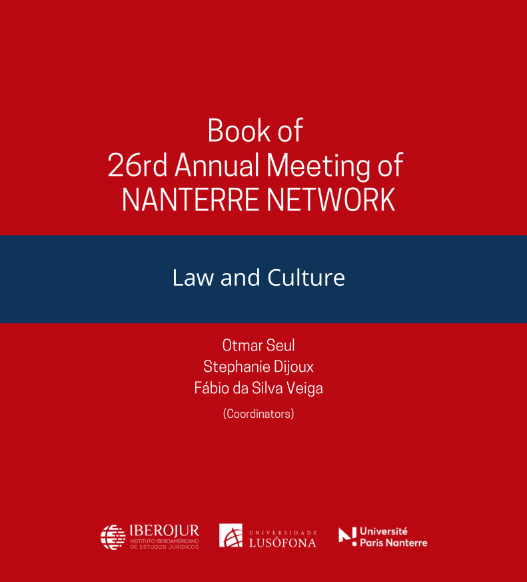
For a quarter of a century, the directors, the teaching staff and the students of the integrated French-German law study programs at the University of Paris Nanterre have been reflecting and designing new models of cooperation with its European and non-European partners. With innovative approaches in teaching and research, Paris Nanterre becomes above all a pioneer for the establishment of transnational Summer Universities in cooperation with partners from countries of the European Union (EU), from EU candidate countries, even from countries outside Europe (Asia, Africa, and South America). As part of their international activities (Nanterre network), the French-German courses organize an Annual Meeting in one of the partner universities, which not only focuses on student and teacher exchanges, but also on scientific cooperation. The traditional Colloquium encourages a comparison of the legal cultures, legal systems and legal practices of the represented countries. After a three-year hiatus due to the COVID-19 pandemic, the Nanterre Network finally returned in 2022 to invite its partners to an Annual Meeting. It was organized by the Universidade Lusófona and the Instituto Iberoamericano de Estudos Jurídicos (IBEROJUR) in Lisbon and Porto from June 28th to July 2nd.
The focus of the Colloquium was “Law and Culture”.
The general theme can easily be assigned to a trend of our time: geared towards the understanding of law in times of a progressive globalization of normative orders, one understands it-going beyond the quid juris question - as a " legitimate subject of cultural studies, to understand central problems of the present’ Just as knowledge of religious worldviews and their dynamics provides an understanding of a conflict-ridden world, the law has a kind of indicative function for paths and wrong turns of a global modernity, the center of which can no longer be determined - neither empirically or normatively. Only the understanding of religiously shaped, decentralized legal cultures allows the specifics of occidental legal cultures to emerge in the globalization process (while) using the analysis potential of cultural-scientific disciplines (...). Contrary to a reconstruction of legal cultures in Max Weber’s work that relies on the profiling of difference, the interweaving, hybridization and partial fusion of legal cultures creates potential for both conflict and reconciliation.
In the first contribution on Legal Pluralisme and Multiethnic Culture, Luísa Brandão Bárrios states that “legal pluralism acquired excellence in socio-legal studies”: “concepts and various trends, maintained the basic idea that the legal is much more than a state law”. With a view to the indigenous movements in the Latin American states, she concludes: “The new political situation, in which inter-, multi-, pluriculturality is gaining legitimacy and the States recognize that ethnic and cultural diversity is an element of it and need to grant specific rights, is based on ethnic plurality and the right to difference, recognition and inclusion within the established”. Profound changes to be attributed to the " reflection of the struggles and demands of the indigenous movement " their identification as social, political and cultural actors has an integrative effect and is conducive to the implementation of the ‘models of citizenship, democracy, state and nation’.
In the second contribution, Charles de Sousa Trigueiro and José Raimundo Ribeiro Campos Filho demonstrate the absolute and universal right to life with reference to the infanticide of indigenous children with disabilities. To carry out their investigation, the authors use the ‘dogmatic method’, such as the hermeneutics of normative texts and jurisprudence, without neglecting the contribution to doctrine and transversality, since it is “an interdisciplinary topic of high political and sociological content, all aligned with a tradition of rationalist thought and grounded in the international hermeneutics of human rights.” By questioning the conditions of existence of this specific social group, the authors move in the field of tension between cultural relativists and universalists of human rights. They understand the normativity of these rights as the universality of the conception that every human being is entitled to some right, deserving due protection by the legal order of the country - however with the restriction that “the absolute character of this right is an exception to the rule of relativization of human rights, since one of the characteristics of human rights is their relativity” (underlining O.S.). With reference to the New York Convention on the Rights of Persons with Disabilities (CRPD), the authors conclude that the right to life of such indigenous children
must be protected by the state. The 3th also deals with the legal protection of a specific social group. Marta Monterroso Rosas presents a comparative study: A dialogue between the recent Portuguese and Spanish Civil Law Reform concerning the support of vulnerable adults. Both countries are endeavoring to adapt their relevant legal systems to the international and European framework, in particular to the Convention on the Rights of Persons with Disabilities.
Persistent differences in their legal systems do not obscure increasing similarities in the reform process in Portugal and Spain. The author particularly emphasizes that judicial measures of support are now reduced to one single legal figure with a unitary regime, yet sufficiently flexible and adaptable to the specific situation of the person. As the measures must be reviewed periodically, courts and judicial practice play a key role in
implementing the new regulations. The periodic review of court-ordered measures is seen as an opportunity to subject the new standards and their application to a process of ongoing discussion conducive to dialogue between the jurisdictions of both countries - promoting “the improvement of new responses to a common challenge”;.
These three contributions have in common their (more or less direct) reference to normative values of the free-democratic basic order of the constitutional state: the focus is on ‘fringe groups’ that require special social protection and social integration. In contrast, the 4th contribution is oriented towards the ‘general interest’ and the ‘common good’. It applies to the topic Public policies for health und the effectiveness of fundamental rights: privacy versus health safety in Brazil and Europe. The issue that João Proença Xavier and Giovana De Morais Figueiredo Cruz want to address is “the extent to which the State can use, disclose or even store our sensitive information, for example, who was vaccinated, when we were vaccinated, what type of vaccine we received, or where we were vaccinated. In addition, we also address the question of whether it is the duty of the State to ensure that only vaccinated people can move and to prohibit the movement of unvaccinated people”.
Reminding that privacy and security are two basic principles that the rule of law must guarantee to the population, the authors recognize that during the Covid-19 pandemic Brazil and the European Union have taken steps to keep the spread of the disease to a minimum. Despite this “undeniably legitimate effort” these countries are accused to compromise - by creating the ‘vaccine certificate’ – the principles of freedom: “Is it right for a state to decide/determine who can or cannot enter certain places in the name of the greater good? Is it fair or even legal, even in this scenario, to make data sharing mandatory without the consent of the data subject? (...) There is no guarantee that data about our health fall only ‘in the hands’ of well-intentioned companies.” Surprisingly, the authors end up considering the ‘vaccination certificate’; - the symbol of the authority to take decisions in the name of a ‘greater good’ and affecting a fundamental individual right - to be the key to a worldwide overcoming of the restrictions: “Would it not be easier and fairer to guarantee the obligation of vaccination at a national and international level for reasons of ‘force majeure’, theoretically avoiding the current prohibition of the movement of individuals? Thus (...) in the near future we may face a new health control, where the presentation of the Covid-19 ‘vaccine certificate’ is, in fact, the ‘next universal certificate’ in order to guarantee all citizens the right to enter supermarkets, chemists, universities, airports and all countries”. In the 5th contribution, Murilo Couto Lacerda and Carolina Merida reflect an aspect of the ‘common good’: using the example of Brazil, they question the possibilities of public agricultural policy to contribute to ‘social well-being’. A term (written in the preamble of the Brazilian federal constitution) that enriches the legal figure of the ‘social state’ with a sociological component. To paraphrase the American sociologist and psychologist Corey Keyes, people are embedded in social systems and communities and thus subject to influences that affect their ‘well-being’. Positive effects are expected in particular from trust in ‘social growth’: “Recognition of the potential that the community contains and the belief that the community can and will develop in a positive direction. The authors assume that Brazil’s constitution (1988) and agricultural legislation (1991) have long provided the legal means to hold government and administration to account. Today, the consistent implementation of the given guidelines in public policies for the development of rural development - agriculture, agri-food industry as well as fisheries and forestry – in connection with the goals of the 2030 Agenda for Sustainable Development of the United Nations (UN), appears to them more than ever as an indispensable stimulus not only for the national economy but also for ‘promoting social well-being’ and ‘reducing social inequality"’. A strategy that has so far failed due to the lack of consensus-building political processes in Brazil: for the authors, the solution to the ‘historical’ misery of his agriculture requires a close partnership between government authorities, production sector, non- governmental organizations and civil society.
The 6th contribution applies to the procedure of the European Commission (EC) in improving international maritime policy and the state of fish stocks. However, in his study of The transposition of the International Organizations’ Decisions into the EU Law, Giorgio Gallizio is not concerned with questioning the common good orientation of European policies. On the contrary: he certifies from the outset that the Commission, as a “prominent actor” within the Regional Fisheries Management Organizations (RFMOs), managed to urge their bodies to “more efficiently protect living marine resources”. His main focus, however, is on criticizing attempts by the Commission to impose measures on EU member states through the RFMOs that “change the balance of power between the EU institutions”. Essentially, he discusses the legal effect of RFMOs’ recommendations. His conclusion: “It would be advisable for the EC to stop stressing the “binding” consequence of the recommendations. There is no doubt that they have a legal effect and therefore must be transposed into EU law. But (...) for this to be done, a formal proposal from the EC is needed in any case to turn the proposal into a regulation adopted by the European Parliament jointly with the Council - except in the case of fixing the fishing opportunities, which responsibility lies with the Council alone. The recurrent assertion that an impact assessment or a wide consultation would not be possible is therefore only a political choice.” A staunch opponent of any revaluation of executive powers in rule-making, the author urges - to maintain the “balance of power” - above all extended control mechanisms in international negotiations - primarily in favor of the European Parliament. As we have seen above, it no longer seems unreasonable to demand a right to social well-being. A quality of life seen as part of a broader, more holistic well- being. We commonly refer to it as happiness: a thoroughly positive term that does not separate ‘sensual happiness’ from ‘spiritual happiness’ and leaves no room for negative associations. The concept of happiness on which the development of both the person and the community is based is two-dimensional: on the one hand, it means securing the basics of existence - i.e. food, clothing, housing, security and social integration - to which the state should contribute; on the other hand, it targets the person’s ability to feel and experience happiness
emotionally.
Happiness research is a more recent field of investigation to which various disciplines are dedicated. For example, positive psychology deals with pleasant feelings and personality strengths. As a human emotion, happiness has not yet been scientifically studied as extensively in comparison to negative emotions such as “fear” and “anger”. Therefore, in their article on Law and happiness, in the 7th contribution, the scientific approach of Marina Garcia de Pina Cabral and Murilo Couto Lacerda is of interest. The two authors unhesitatingly affirm the question of whether the law can make a fundamental contribution on the way to happiness: “Happiness in law seems not hypothetical (...). Happiness can be related to the law and integrated into the legal system as a norm, because it is an intrinsic search of the human being and really something very valuable and fully attainable. We can recognize our right to be happy." Their historical sources of inspiration are philosophers who conceptualized the term happiness, primarily Aristotle, whose considerations on the subject justified happiness as a ‘right’. As this highest level of well-being “passes through human virtues, composed of intrinsic and extrinsic factors, being essential for the experience of the human being in society”, the authors appeal in their considerations obviously to the aforementioned ‘two-part concept of happiness’. It presupposes certain social preconditions: “People need to be equipped with conditions (absence of pain) that are extremely important for their wellbeing such as food, security, education and other fundamental rights. If all people fully enjoyed these rights, society could be happier.& quot; The State is thus obliged to act in a targeted manner: “It is important to emphasize that not only social rights guarantee happiness. They must be in line with the core of freedom, equality, and dignity. The State could contribute to the search for the happiness, through public actions (within the judicial, legislative, or executive power), considering the consequences of these actions, opting for one that contributes to increasing happiness for the greater number of people.”
However, a basic right to happiness is only guaranteed in the Constitution of the Himalayan state of Bhutan, since 2008. It thus differs from the right to the pursuit of happiness, as formulated in the United States ‘Declaration of Independence: it guarantees concrete conditions of ‘personal development’ through the introduction of an index for measuring Gross National Happiness (GNH). The Index questions the relevance of the link between economic prosperity and happiness, and commits governance to consistent intangible improvements in quality of life, such as education, balanced use of time, community or cultural vitality, and mental health. The Bhutanese model is discussed in Western societies and has shaped since 2012 the annual ‘World Happiness Report’ of the UN Sustainable Development Solutions Network. The Report ranks countries according to their happiness scores, measuring phenomenon using six core variables: gross domestic product per capita GDP), social support, healthy life expectancy, freedom to make life choices, generosity and absence of corruption.
Wenn Rechtskulturen – wie eingangs erwähnt – nicht nur Konflikt- sondern auch “Versöhnungspotenziale” (Käte Hamburger Kolleg) in sich bergen, so gilt es diese zu erkennen und zu fördern. Damit fällt nicht zuletzt den Universitäten die Rolle zu, als Kulturträger zu wirken und ihre Studierenden an ‘Werte’ heranzuführen, die unerlässlich für ein demokratisch funktionierendes supranationales Staatswesen sind, wie es die
Europäische Union sein will.
In the 8th contribution, weist Otmar Seul auf die Pionierrolle des von ihm begründeten Kooperationssystems hin: The Nanterre network and its intercultural approach for civic and citizenship education: Franco-German and European Summer Universities in Law. A geopolitical synthesis (2004-2020). These Summer Universities allow the discovery of national legal systems and an analysis of their differences and similarities. The competence to ‘interact’ with individuals and groups from other legal cultures is conveyed in ‘workshops’ for students and doctoral candidates. As an integral part of civil society, students should become ‘actors of change’. A role that they claim in Germany and France since the protest movements of the 1960s.
In the 9th and last contribution, Viviane Macedo Garcia makes a comparative study of arbitration in Public Contracts in Brazil according to the interpretation of the jurisprudence of the Superior Court of Justice and the use of consensual means of conflict resolution by the Public Administration in Portugal.

Este trabalho está licenciado sob uma licença Creative Commons Attribution-NonCommercial-NoDerivatives 4.0 International License.



Autores
Termo de Uso
Política de Privacidade
 O licenciante não pode revogar estes direitos desde que você respeite os termos da licença.