Autores Proeminentes


PREFACE
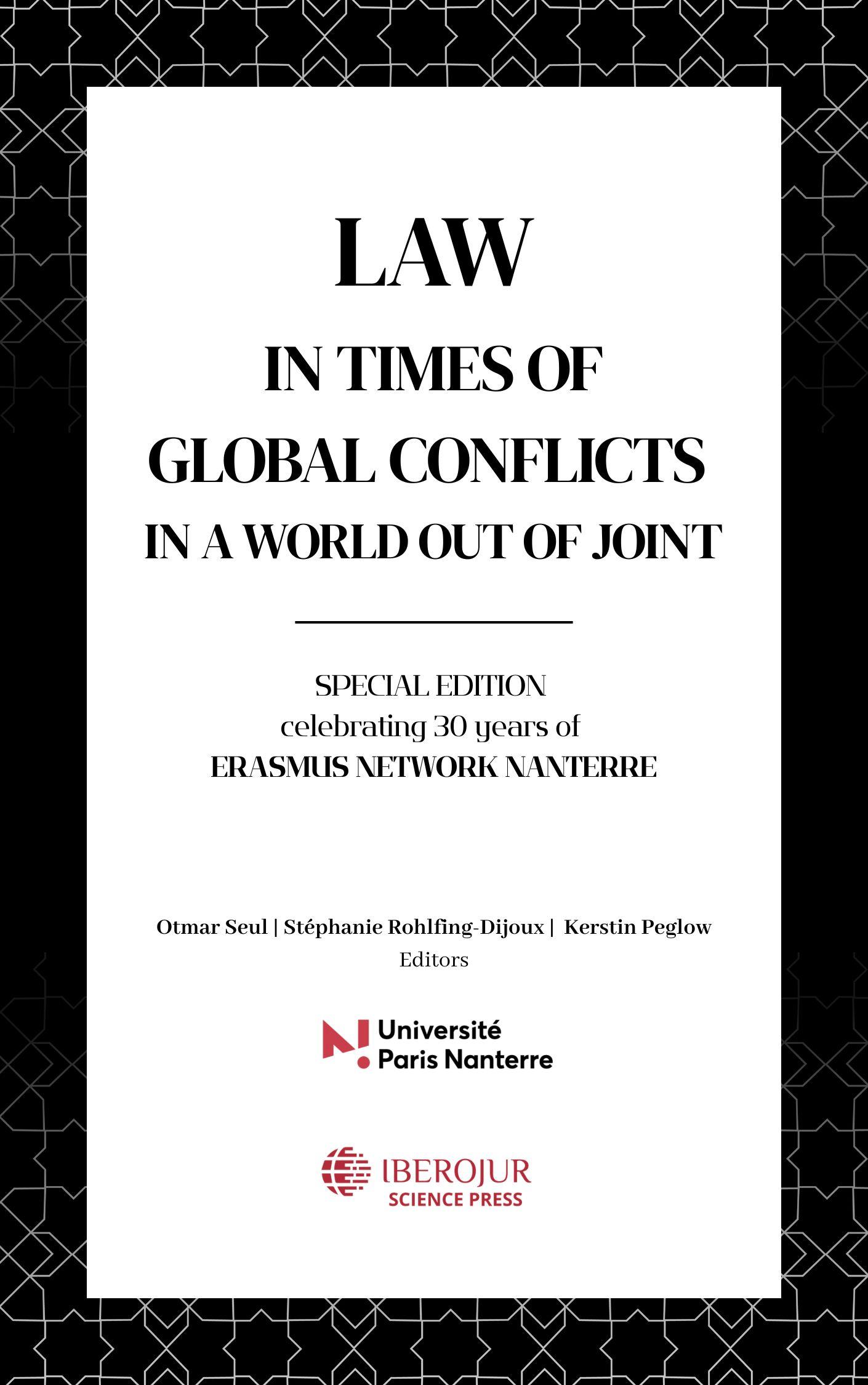
The European academic cooperation network – the “Nanterre Network” – is celebrating this year its 30th anniversary. Founded in the 1990s by Professor Otmar Seul, the Network aimed to embed the integrated French-German Law Curriculum from the University Paris Nanterre within the European Higher Education and Research Area.
Built on agreements under the Erasmus Program, this informal network has evolved in different phases. First, in the wake of German reunification (1990), it incorporated law faculties of Humboldt University of Berlin, Potsdam, Frankfurt/Oder and Dresden (TU), along with other universities in former Eastern Germany. Second, from 2000 onwards, it expanded to include universities in Central and Eastern Europe — notably in Poland and the Baltic states — sometimes even before their countries joined the European Union in 2004. Third, from 2006, it extended to several Turkish universities. Nowadays, the Network spans all over Europe, it includes Spanish, Portuguese, Italian, Austrian, Swiss and Belgian universities. As a very recent development, partners of the Paris Nanterre University within the EDUC – European Digital UniverCity – Alliance joined the Network: Masaryk University in Brno/Czech Republic, University of Cagliary/Sardegna/Italie and Jaume I University in Castiglione/Spain.
Since 1995, representatives of partner universities have met regularly. Following the Bologna Declaration, these annual meetings — held in cities such as Prague, Vilnius, Łódź, Riga, Paris, Fribourg (Switzerland), Istanbul, Sevilla, Barcelona/Andorra, Berlin, Lisboa, Vienna, Potsdam, Salamanca, Porto — have focused in particular on aligning national higher education systems with European standards. Combined with symposia or study days, these gatherings also provide a forum for reflection on broader trends in the ongoing harmonization of law across the European Union.
In this volume, published with the support of the Instituto Iberoamericano de Estudos Jurídicos – Iberojur – Porto, we present the papers delivered at the Nanterre Network meetings held in 2024 in Salzburg, Austria, and in 2025 in Cagliari, Italy. The publication is dedicated to the 30th-anniversary meeting of the Network, which will be hosted by the University of Szeged, Hungary, in late May 2026.
In 2024, we were welcomed at the Paris Lodron University of Salzburg by our long-standing Network fellows and visiting lecturers in the French-German Curriculum at University Paris Nanterre, Ulrike Brandl and Günter Herzig. Many years ago, University Paris Nanterre concluded an Erasmus agreement with Paris Lodron University Salzburg, which has proven highly successful and remains particularly popular among students. In 2025, we were hosted by Massimiliano Piras and Christian Rossi at the University of Cagliari, Sardinia. In recent years, we have also organized joint digital lectures with our Italian colleagues within the EDUC Network. In addition, in-person meetings involving students and faculty from the partner universities continue to take place; in 2025, such a meeting was held following the Network conference in Cagliari.
The internationalization of our programs has become an established reality for our students, who now travel and study across the globe. Many of them have never experienced a time without Erasmus. After the COVID-19 pandemic, which temporarily interrupted international exchange activities, mobility has now returned to, and in some cases surpassed, previous levels.
Nevertheless, the global context has changed significantly. The political environment has evolved in ways that give cause for concern: in 2020, the United Kingdom left the European Union; in 2022, war broke out in Ukraine; and in 2023, armed conflict escalated in the Middle East. Across the world, we observe political leadership that appears ever more indifferent to fundamental democratic principles. In Europe as well, democratic values are under pressure, while profound societal transformations—driven in part by social media, artificial intelligence, digitalization, and advances in medicine—are becoming more pronounced. At the same time, the economic situation within the European Union is a source of growing concern. China has emerged as a major global actor, and Europe faces increasing challenges in global competition, particularly in key technologies such as semiconductors and artificial intelligence. The resurgence of protectionism, especially in the United States, further contributes to a progressively constrained economic climate.
In parallel, our natural environment is under mounting strain. Media reports frequently depict devastating floods that claim lives and impose immense economic costs, while, in stark contrast, severe forest fires recur each summer. Armed conflicts further exacerbate environmental degradation, destroying ecosystems and undermining the livelihoods of countless people.
In response to these challenges, the United Nations adopted the Sustainable Development Goals (SDGs) in 2015 as a universal call to action to end poverty, protect the planet, and ensure peace and prosperity for all by 2030. Yet, in light of the growing frequency of armed conflicts, human rights violations, and environmental destruction, we remain far from achieving these objectives. Global governance continues to suffer from a lack of binding legal frameworks, and even where such rules exist, compliance is becoming more uncertain.
At the same time, there are also encouraging developments. Within Europe, efforts are underway to address environmental harm and human rights violations linked to the activities of multinational companies through both national legislation and European Union law. Sustainable development has become a central objective of the European Union, notably under the European Green Deal, and non-binding international standards are more frequently being transformed into binding legal obligations.
Against this backdrop, the themes of the Nanterre Network meetings in 2024 and 2025 addressed these pressing issues from a legal perspective. The 2024 meeting focused on “Time and Law – Out of Joint?”, while the 2025 meeting examined “Challenges to Achieving the Sustainable Development Goals (SDGs) in Times of Global Conflicts and Climate-Related Emergencies.”
The current edition brings together a wide range of contributions reflecting the diverse academic specializations and research interests of the members of the Nanterre Network. In a time of global crisis, our commitment to academic exchange and cooperation between our universities is more important than ever. We are therefore particularly pleased to dedicate this publication to the 30th anniversary meeting, which will address the theme “Minority Rights and Advocacy in the European Union and Beyond: Successes and Challenges.”

Esta obra está bajo una licencia internacional Creative Commons Atribución-NoComercial-SinDerivadas 4.0.



Autores
Termo de Uso
Política de Privacidade
 O licenciante não pode revogar estes direitos desde que você respeite os termos da licença.